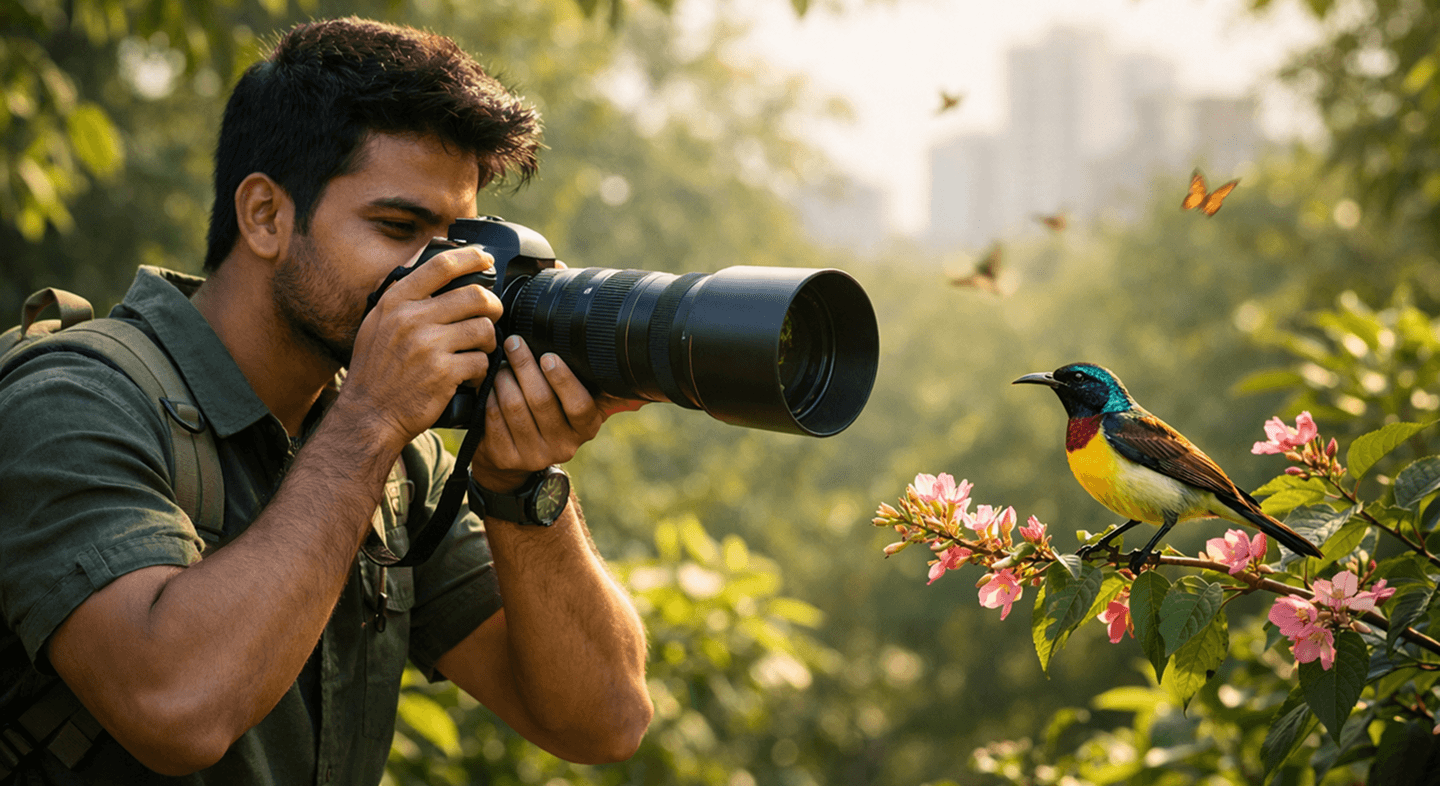
Today birding counts iPhone holding teens & obsessive “listers” among its ten millions of participants, making what was once an eccentric hobby into something so completely mainstream it’s now almost cool. While struggling to click one perfect DSLR equipped shot of a sunbird hovering outside my office window sill, I pondered upon how the pioneering efforts in birding & ornithology would have been chronicled. Today, these chronicles are just a click away for young digitally equipped birding enthusiasts. I decided to have a sneek peek on the major trends, ideas, campaigns & thinkers within the birding’s adventurous spirit. I have tried to fly across birding chronicles in one country is transformed by infusions from outside.
In India, The Fall of a Sparrow takes us back to the real life story of adventure & self-discovery of Salim Ali, India’s original bird man. It speaks volumes how the pioneer contracted the germs of ornithology at a time when the disease was practically unknown among Indians. He vividly remembers his first bird note in the year of 1906 on a sparrow nesting in the hole of a harness with one loose peg at his Khetwadi stable.Crude & incomplete as it was when rediscovered nearly sixty years later the gist of the note seemed relevant enough for publication in Newsletter for Birdwatchers.
Around the same time, exactly across the globe birding was becoming a popular hobby in America, especially after World War II, fuelled by greater leisure time, affordable optics & good field guides that made sense. But the bird study, the foundation on which modern American birding rests, goes back much further than that – back through the nineteenth centur, when frontier ornithologists risked an arrow between the ribs to collect new birds, back through the eighteenth & even the seventeenth centuries, back to the dawn of colonization, when the avaian wonders of new continent were unfolding. Although, the Indian ornithology scenario was far from nascent at that time, interestingly, the first American field ornithologists were the Indians. Their knowledge of birdlife was based on deep association, long observation & at times lifesaving necessity. Birds featured prominently in the social, religious, medical & gastronomic life of North America’s myriad native tribes.
Dr. Salim Ali, describes his serious obstacles of absence of illustrated books on bird identification in India while developing his outdoor bird hobby. Thus, most people who contributed to early bird study in India were Engishmen. This brought out Jerdon’s Birds of India in 1864 & later four volume publication on Indian avifauna by Oates & Blanford in 1898.
On the American front as well, young Englishman Mark Catesby did pioneering efforts of describing, collecting & painting the plants & animals of the Southeast in 1712. From the moment Europeans arrived in North America they were awestruck by a continent awash with birds – great flocks of wild pigeons, praires teeming with grouse, woodlands alive with brilliantly plumed songbirds.
The scientific rigor to these earlier accounts was brought in by the Catesby’s book which is generally credited with being the first true ornithological text dealing with American birds.