The Mahatma  : Vocal about Local

Every Indian is aware of the Mahatma’s work in the freedom struggle, but few know of his relationship with the environment. 150 years after he was born, how relevant is Mahatma Gandhi with today’s environment? His face still adorns currency notes, street names & postage stamps. But do his values, messages or sacrifices reflect on the streets or economy or our interactions with the environment we live in? To some, his relevance with the present environmental damages may seem to be impractical or hindrances for progress. Gandhian thoughts on environment came with practice towards better air, water, land & quality of life. They were far ahead of time to be hash tagged as sustainable. They were not with extremism, as environmentalism did not exist before industrialism.

As early as 1924, Gandhi remarked, “In nature there is fundamental unity running through all the diversity we see about us”

The developed nations have chosen lifestyles at the cost of all resources of developing nations. To enlarge the gulf between rich & poor they continue to send in their waste to developing countries. Before India gained independence, Gandhi was once asked if he expected India to attain the same standard of living as Britain. Gandhi replied, “It took Britain half the planet to achieve this prosperity. How many planets will a country like India require!” On another occasion he said, “God forbid that India should ever take to industrialism after the manner of the West. The economic imperialism of a single tiny island kingdom is today keeping the world in chains. If an entire nation of 300 million (population of India at that time) took to similar economic exploitation it would strip the world bare like locusts.” This thought needs to be mutually respected by today’s youth of developed & developing nations.

The Mahatma, was averse to India following the west blindly, but was for judicious use of science and technology for the good & well being of human kind as long as it did not ruin the balance in nature. To keep all the science simple he said, “The earth provides enough for everyman’s needs but not for everyman’s greed.” Those are simple words for today’s consumerism issues.

Comprehending the needs of progress Gandhian views brought in the understanding that production should be by masses & not mass production; production should be need oriented & not greed oriented.

I am born in the age where online shopping is a reality and these days it seems fashionable to call oneself environmentalist. Even if one were to uphold these modern day concepts one could practice Gandhian thoughts as he said, “all should make it a point of honour to use only village articles whenever & wherever available. Given the demand there is no doubt that most of our wants can be supplied by villages. When we become village minded we shall not want imitations from West or machine-made products.”

Shiv Vishwanathan’s interpretations on Gandhian science says, “ Gandhi was never sentimental about nature. He realized that most forms of work involve some violence to nature but one must seek to minimize it.”

Dr. Khoshoo & Prof. Moolakkattu analyze that Gandian environmental thoughts and ideas  of village self-sufficiency & self-reliance provide us a powerful way to resist the forces of globalization that are extractive and exploitative of people & natural resources.

This Gandhi Jayanti there is a need to ponder upon Gandhian values instead of merely garlanding portraits and try to translate his ecofriendly approach into real life. To sum up with the Mahatma’s words “Wildlife is decreasing in the jungles, but it is increasing in the towns.”
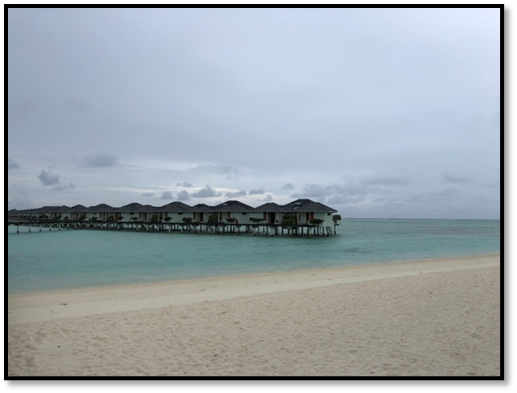
Mystifying Maldives !

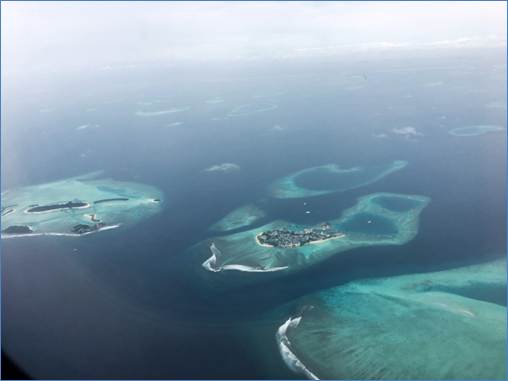
Gazing down on all the small islands dotted around in the turquoise lagoons is a breathtaking experience, to realize that you are just few minutes away from landing onto the paradise of this planet. Let’s have a peek into this paradise, as I land on the most beautiful beaches in the world, famous for its soft white sands & sea water that sparkles in numerous shades of blue. However, this is just half of what makes the Maldives so special. There is a whole mesmerizing life beneath the surface of the ocean.

Maldives is formed of 1200 islands & stretches from north to south over a length of over 800 kilometers in the Indian Ocean. The country is made up of 26 natural atolls; ring shaped reefs with several islands in each of them. The southernmost group of atolls are located south of equator.

Maldivians have depended upon their country's marine resources & tourism in every aspect of life & survival. Tourism in Maldives is dependent entirely on its pristine environment. This pristine environment is made up entirely of coral atolls & reefs; the Maldives has a unique & delicate marine environment. As such tourists are advised not to touch or extract corals or other marine species when diving or snorkelling. Several areas are protected and collection and export of several marine species are prohibited. While speaking to Rizwan & Dhaitha, young Maldivians I realized that the youth takes pride in their countries rich marine life but at the same time believes that tourism only, is going to help to conserve & develop it in the longer run. They value their free dives into the marine biodiversity underneath the surface which has been alluring guests across the globe to their paradise islands.

Lot’s has been written & said about the impacts of tourism on the Maladives. There is no doubt that small Island states are at the frontline of climate change impacts & sea level rise. Also, the future economic prosperity of the Maldivian economy is clearly dependent on guaranteeing the sustainability and status of these natural assets.

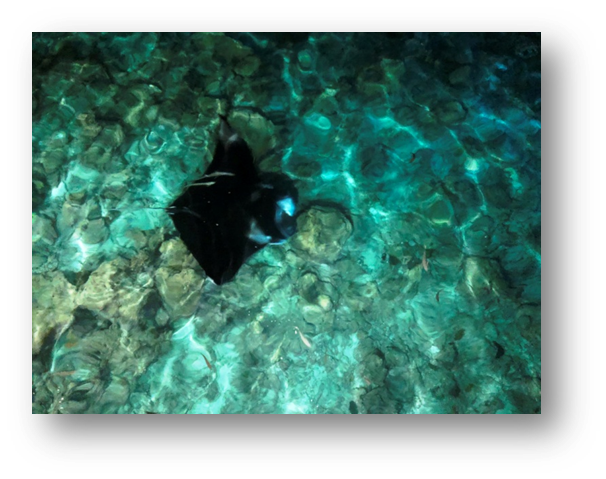
Some of the marine species which have been enthralling the scuba divers & snorkelers across the globe are manta rays, sting rays, whale sharks.

 Environmental management, including biodiversity conservation & the sustainable and equitable use of land, water and other natural resources, is relatively new to the Maldives.

As, more & more guests putting pressure on the carry capacity of the islands, the resorts are now venturing into untouched, virgin & unhabitated  islands further away from Velana International Airport. This is one aspect which in changing times needs to refrain. Let

them be as they are for a better tomorrow, for Maldivians forever, for the richness of marine life who have equal sharing rights over the turquoise oceans! For our kids to know how magnificent are living corals!

The islands already overflowing with guests are indebted to lost living corals & reefs which are now just lying as lime stones on the soft white sands. As I dived deep into the South Ari atoll, I realized that only capturing memories for lifetime than photographs, gleaned more reverence to tranquillity of marine organisms beneath the luxury above.

The luxury of islands running completely on DG Sets, having bottled water sourced from all over at the expense of in debt locals & with almost no terrestrial biodiversity left. Meanwhile, the plastic & other waste which guests happen bring along with happens to be secretively dealt with nowhere to go to! Yet, there is always hope & scope to make this world a little more perfect! For that, I was glad to stay on resort with a meaningful conservation programme. The dive center here, has established rehabilitation programs for growing artificial coral reefs and recolonizing the existing ones. Just a small step for me to start with!

Future of Nature: Orientation

Years ago, as a Masters student of Life Sciences, I entered a busy lab filled with all state of art equipments & PhD. thesis piled up the shelves. The researchers were pouring into various analytical flasks & peeping into automated microscopes. The smell of agar & media was the first fragrance of research I got. Each lab mate was so engrossed in their tiny little specimens that the noise of the rotary shaker & the vibration of the old incubator were completely oblivious to them. This lab environment took my anxiety levels higher up, as I was more than excited for meeting a Scientist G in the next lab room.

As a kid, when I was interviewed for a children TV show, I had a dream to be scientist. I revered an image of a national scientist who made grand innovations & applications which built the future of India. As a kid, I often sketched out a man with a lab coat & bespectacled till the nose with few test tubes on the desk & smoke fumes coming out of a flask. So, now grown up, moving into the next lab room to meet a Scientist G was a big deal for me.

As, I entered the next lab I saw an old man sitting on a cane chair, in simple humble clothes and completely buried into his old desktop & between a heap of research papers & hard bound thesis. As I overcame the cordiality of interacting with a renowned scientist, he asked me what I would like to work upon. As couple of days passed by, I was lucky to get direct conversations with him & his way of orientation towards research & academia. He asked me a simple question of what to do you foresee in the next 20 years for research required in India. I did not have an impromptu answer, I so requested for some time & during that read a lot on what all flashed across my mind at that stage. He then oriented me to think what could be the issues in land, food & agriculture 20 years down the line. His orientation was towards how biological pesticides would be of importance in solving those issues. No sooner, through his mentoring I realized that, this was his humble way of orienting me towards a career I like and also comprehending its importance. I was lucky to work under such a scientist mentor who could build a thought provoking ability towards a career goal in life. It brought the importance of basic science towards applied science. It today helps me, encounter the gap between research, academia & market in my daily routine as an ecopreneur.

Today, when I often try to bring in lab jargon towards common citizens dealing with solid waste management & composting techniques, this very thought provoking ability becomes a handy tool to understand what could be the future of nature … say 20 years down the lane. The journey of lab to market for any product or innovation starts with lot of scientific jargon but eventually has to answer the humble questions of market which could be as simple & robust as weight, smell, religion & money! The entire lab jargon of automation & innovation goes for a full toss while trying to convince the person across the table who is least concerned about his own future, leaving aside nature!

That’s when I realize this huge gap of us humans in understanding the future of nature! It is a phrase which needs to be thought upon with the same importance we see the financial investments for our kids or the loans we take in to have a safe roof for the fag end of our life.

At a time when the global economy is growing and the poverty rate is the lowest in recorded history, it would be easy to become complacent and overlook looming challenges of natural disasters. Talks are critical on the topic of future of nature, until we hear the cries of our beloved, deep down in the tsunami, floods or earthquakes!

When we consider the scope of the challenge to prepare for the future of nature, it is important to understand that many children currently in primary school will work in a land where trees are in small terrarium bottles & breathing air in cylinders.

No matter who we are, or what we work for, it is not going to happen if can’t breathe the air and drink the water. It’s high time we orient our human minds towards this thought!

~ Prachi Nimkar

Flying across: Global Birding History

Today birding counts iPhone holding teens & obsessive “listers” among its ten millions of participants, making what was once an eccentric hobby into something so completely mainstream it’s now almost cool. While struggling to click one perfect DSLR equipped shot of a sunbird hovering outside my office window sill, I pondered upon how the pioneering efforts in birding & ornithology would have been chronicled. Today, these chronicles are just a click away for young digitally equipped birding enthusiasts. I decided to have a sneek peek on the major trends, ideas, campaigns & thinkers within the birding’s adventurous spirit. I have tried to fly across birding chronicles in one country is transformed by infusions from outside.

In  India, The Fall of a Sparrow takes us back to the real life story of adventure & self-discovery of Salim Ali, India’s original bird man. It speaks volumes how the pioneer contracted the germs of ornithology at a time when the disease was practically unknown among Indians. He vividly remembers his first bird note in the year of 1906 on a sparrow nesting in the hole of a harness with one loose peg at his Khetwadi stable.Crude & incomplete as it was when rediscovered nearly sixty years later the gist of the note seemed relevant enough for publication in Newsletter for Birdwatchers.

Around the same time, exactly across the globe birding was becoming a popular hobby in America, especially after World War II, fuelled by greater leisure time, affordable optics & good field guides that made sense. But the bird study, the foundation on which modern American birding rests, goes back much further than that – back through the nineteenth centur, when frontier ornithologists risked an arrow between the ribs to collect new birds, back through the eighteenth & even the seventeenth centuries, back to the dawn of colonization, when the avaian wonders of new continent were unfolding. Although, the Indian ornithology scenario was far from nascent at that time, interestingly, the first American field ornithologists were the Indians. Their knowledge of birdlife was based on deep association, long observation & at times lifesaving necessity. Birds featured prominently in the social, religious, medical & gastronomic life of North America’s myriad native tribes.

Dr. Salim Ali, describes his serious obstacles of absence of illustrated books on bird identification in India while developing his outdoor bird hobby. Thus, most people who contributed to early bird study in India were Engishmen. This brought out Jerdon’s Birds of India in 1864 & later four volume publication on Indian avifauna by Oates & Blanford in 1898.

On the American front as well, young Englishman Mark Catesby did pioneering efforts of describing, collecting & painting the plants & animals of the Southeast in 1712. From the moment Europeans arrived in North America they were awestruck by a continent awash with birds – great flocks of wild pigeons, praires teeming with grouse, woodlands alive with brilliantly plumed songbirds.

The scientific rigor to these earlier accounts was brought in by the Catesby’s book which is generally credited with being the first true ornithological text dealing with American birds.