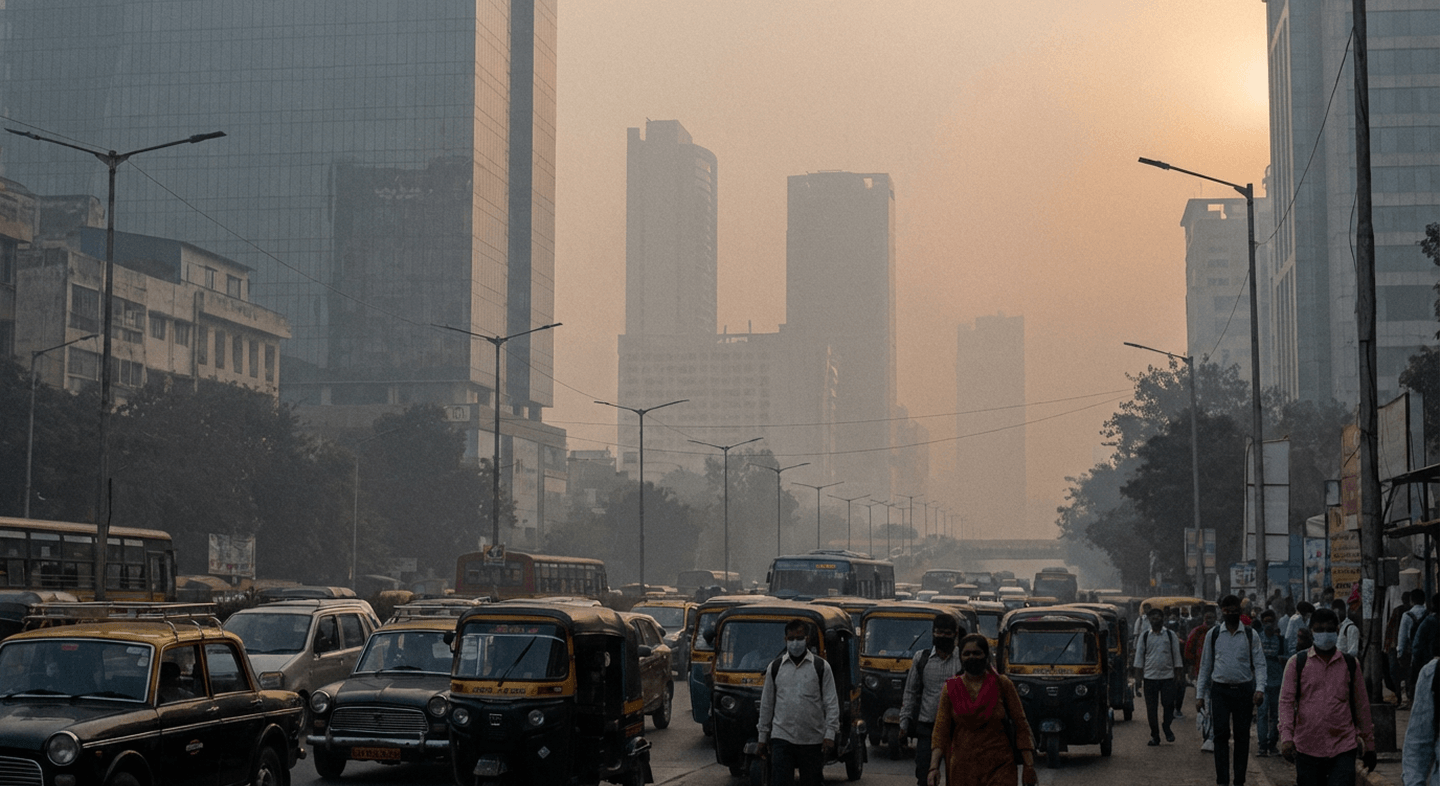
In a time when the water and ecological crisis has been recognized worldwide and the urgency of taking actions towards water conservation has been pointed out, it is critical to understand man’s environmental orientations, how they are formed and what can be done in order to building a higher water concern amidst masses. As Paul Shephard has rightly said that human sanity requires some less than obvious connections to nature as well as the necessities of food, water, energy and air. We have hardly begun to discover what those connections may be. In cities like Mumbai, the urban luxurious needs have sucked up the basic water necessities of the rural areas around it. In such appalling conditions it’s time to unfold these very human connections to nature. It’s time to change the migrating rural population’s perception that smoke & foul air in cities are not signs of economic status but are aesthetic evils with major causes of human diseases. A change in local, urban & national attitude towards water is the crying need of the day. Buzzwords like “eco-friendly”, “sustainable” & “green economy” need to be understood by the masses in the true sense & not for the sake of “eco” labels & brands.
Environmental laws have been established & abused far away from being implemented or creating mass awareness. But what are the answers to this tragedy or water abuse we see around as a way of life ? The goal of my writing is to provide a better focus on the approach we need to take to stop water abuse as a way of life.
Both the causes & consequences of water crisis are, of course, research problems well within the purview of psychology of humans / citizens. As yet, the psychological community in Mumbai has contributed little to the water debate in Mumbai. By contrast, environmental journalists, media, social activists and natural scientists have contributed significantly to our understanding of the social implications of water loss or crisis. But the psychology of citizens wasting water has not been adequately addressed.
Economics has been referred to as the “master discipline” of development in Mumbai and its own neglect of the ecological dimensions of human life has been reproduced within the other psychological sciences as well. It is only in the recent years with the strict enforcement of water supply procedures and environment clearance processes have been hindering the rampant development in the city. Till then any talk of water supply or ecological constraints to economic activity was regarded at best as irrelevant.
Consequently, the intellectual climate of this metro planning has been marked by a profound indifference to human interactions with the water as a natural resource.
At a day to day level the majority of Mumbaikars are faced with more prosaic but equally significant water problems. Serious crisis in the quality and availability of water, excessively high rates of urban & industrial pollution and a continuing loss of water, a vital resource are indeed coped by virtually every segment of this urban society. Littering into water sources, foul odour from open nallahs, open drainage of effluents, inefficient sewage systems and treatments, etc have become a part and parcel in a daily routine of a Mumbaikar. Diversity in waste water & unhygienic slums is the only “scenic” landscape (pun intended) one can see amidst the concrete jungle after affording an escalated real estate. After perspiring & shelling Rs 15,000 per sq. ft for a modest home in the suburbs one would be allocated with an open nallah or drain, right at the doorstep and ironically no water in the tap inside the door.
How then does a psychological approach modify the basic assumptions of water crisis?
Today there is little recognition that this water crisis in Mumbai is indeed a psychological one.
Ecologists study nature while psychologists study human nature. Assuming these natures overlap, psychology already has obvious potential links to ecology.
While humans are unique amongst the earth’s creatures in their elaborately developed culture, they do not stand above or apart from nature.The demand here is also to find ways to talk about human-nature (water) relationship that do not set humans outside of nature, that is clarify how it is that we Mumbaikars relate to nature or water as a natural resource while also being an embodied part of nature, involved in its water cycle ourselves.
Taking lessons from the recent tsunamis, cloud bursts & other consequences of climate change in different parts of India & other countries, the ecological infrastructure of Mumbai shall powerfully condition the evolution & direction of human economic life, political relations, social structure & ideology of this metro city which is the so called financial capital of India. Just imagine the loss if any of the consequence of water calamities hits on the same massive scale on Mumbai. The escalated development shall be futile in a matter of few seconds. When such consequences of environmental degradation strike, it shall make no discrimination in rich or poor, caste or creed. A tsunami in Mumbai will not be able to differentiate a Dharavi slum dwelling or a lavish duplex at Marine lines. All are equal under one wave.
Therefore, the initial challenge for psychologists and ecologists is to counter this deeply ingrained habit of ignoring the psychological significance of human nature relationship in Mumbaikars of all strata of the urban society.
Presently decision makers have been working from a narrow range of motivations, the statistics of impending disasters & the coercive emotional force of fear and guilt. They overlook the reason, the perversity, the sick desire that lie at the core of the psyche. Their strategy is shock and shame. The implementation of policies needs to be where all thoughtful people will find much within to provoke and stimulate altered ways of thinking and feeling. Strict fines have lead to organizing, educating, agitating and giving privileges to corruption with little regard for the fragile psychological complexities of the public whose hearts and minds it seeks to win.
Implementation of policies needs to seek to acquaint the save water movement with a subtler more sensitive psychological approach to the public it seeks to win over to its cause. They must learn to facilitate the inner changes in the public that will help bring about the policy and behavourial changes of masses towards using and reusing water.
We the people, can acknowledge that we are part of the habitat, part of the network, part of the web of water cycle then only we can see the change we desire. This is the very strategy of interdisciplinary approach of environmental sciences & psychology – ecopsychology an approach to water conservation.
This approach synthesizes ecology and psychology, placing human psychology in an ecological context and mending the divisions between mind and nature, humans and water.
This schema can explain the evolution of sub disciplines with environmental science & psychology such as : eco psychology, social ecology, psychology within urban social structure – social psychology. Essentially, a water perspective considering the current scenario adds a sub discipline to the scheme – the ecological or water infrastructure of urban society – that is rivers, streams, lakes, ponds, springs and biodiversity associated with them.
It shall introduce psychology which has been a neglected dimension in environmental sciences & water awareness.
The Psychological Task is to acknowledge & better understand the Human – water Relationship. Without psychologically challenging cultural backgrounds (beliefs, values, attitudes) and social arrangements (institutions, material conditions) that have historically sanctioned water abuse nothing much will change. The first principle in this is to accept that we have to renew what already exists.
How could this psychological task be implemented? Through exercises aimed at freeing up painful emotions over our society’s destructive relation to the water as a natural resource and at deepening a sense of identity or connection with other than human being participants which shall support to become more “water conscious” and people are allowed to “express their awareness about the water trouble we are in and deepen their motivation to act”.
If this interdisciplinary approach is to be relevant to a world desperately seeking sustainability and water abundance the challenge cannot be denied. The reader will have noted two potential tensions, one dealing with scale (the individual versus social aggregates such as communities), and the other with whether dependence can be measured as a psychological state or behaviourally.
But once we decide to overcome these 2 potential tensions we find the worth of the potential utility and implications of this interdisciplinary approach.
The entire interdisciplinary approach can take place over a number of days and proceed through three typical stages which spontaneously flow one into other. The first stage involves using exercises to evoke the dreadful social and water realities of our times. This expressive process sets the ground for the second stage in which people come to realization stage. The third and final stage is called “empowerment” in which people experience their personal power, broaden their vision of what is possible and acquire skills for social change work.
To explain precisely with an example, our cities have been built to work on the available resources. Our fore-fathers were wise in building lakes and ponds to harvest every drop of rain. This ensured that the city recharged its water table and did not face floods every time it rained. We need to understand and revive that system. We need to reduce length of pipelines and reduce distribution losses. Once we do this we should add the smartest technologies for measuring supply and for reducing demand. Flush toilets are obsolete. We need smart appliances to conserve water and smart ways to recycle it.
One cannot be oblivious to the scale at which these three stages need to be carried out. For that the expertise of psychologists & ecologists could design programs at grass root levels & common public locations of Mumbai & its suburbs. These programs need to be designed in such a manner to be free of corruption loopholes & should be able to create a wake zone in the daily routine of every Mumbaikar. For that the programs need to include:
1. Zest: type of vitality and energy that comes from positive interactions
2. Action: This is informed in a more complete way because of the interplay between individuals
3. Knowledge: or the more complete picture individuals have of themselves and their relation with natural resources
4. A sense of worth: This comes from feeling worthwhile after taking a positive endeavour towards water conservation.
5. Desire: to form more empowering connections and spread the important message.
The strategies of these programs need to be modifying the human addictive behaviour towards water abuse.
The State authorities could create & fund opportunities for young psychologists & ecologists to conduct this mass water awareness across the different sections of society. To bridge the gap of time, they could provide materials designed by expertise for skill building groups in modules at different sub centres.
The modules a young team of psychologists & ecologists could conduct on the following:
- Focusing on the strength of individual & water environment of Mumbai ...eventually masses
- Understanding the illness of water abusive & wastage addictive behaviour
- Reducing the water abusive & wastage addictive behaviour
- Connecting people to implement actions
- Expressing positive feelings of the masses
- Getting closer to the practical issues of the people
- Standing up for the water cause in a positive way
- Managing aggression for water amidst society
- Using Time well
- Avoiding problems with corruption & other loopholes
The modules could be organized in a particular order or can be altered to match the needs of the group members & the agency.
The first two or three sessions in each module would provide information, raise awareness, and identify a range of strategies & help people to apply what they are learning to their own experience. The last two or three sessions shall build on increased understanding & motivation by teaching specific skills. These skills shall be practiced in and outside sessions.
The Ecological Task would involve environmental laws, setting standards & monitoring the changes acquired through this interdisciplinary approach. Environmental law is mainly concerned with the promotion of environmentally positive behaviours & the diminution of environmentally harmful behaviours. It cannot achieve these goals simply by existing: it must be applied through several legal “mechanisms” or “techniques”. The range of techniques that the current law has at its service includes:
- ‘Direct’ or ‘command and control’ regulation
- Self regulation
- Provision of environmental information & education
- Judicial review & citizen suit
- Environment protection through property rights
Reliance on a single technique is never wise and any hope of creating a water stable future will require a prudent mix of each approach. Water usage laws in Mumbai can be structured to best facilitate each technique. However, getting the mix right is essentially a political question that the government & political institutions must decide with the expertise of ecologists & psychologists.
The ecological tasks would include informing the people the science of water crisis due to their water abusive behaviour. It would have to come to the level of a layman to understand the scientific jargon of ecological processes & its importance in their life.
The current environmental laws have assigned agencies to regulate environmental laws. But because of the lack of public involvement in agency decision making processes and lack of transparency of such processes it can often be difficult for the public to be certain that full consideration has been given to the water risks inherent in a given activity. Obviously, individuals can only make judgements about water risks if they are not provided with clear & pertinent information about the same. This is one reason why laws giving rights of access to water information are so important. Also, this would imbibe water responsibilities in every individual concerned.
To successfully carry out the ecological task in this interdisciplinary approach environmental ethics in law are crucial. Environment ethics & law are two distinct yet potentially related means of achieving the shifts in human behaviour that are necessary to prevent or slow the trend of significant environmental damage.
The approach would lead to increased public opportunities for protection of local water sources. While personal freedom to re-engage with nature may need to be increased (as a prerequisite to enhanced ecological sensibility) personal freedoms that depend on nature exploitation may need to be curbed.
In attempting to answer the current water issues of Mumbai, every Mumbaikar shall soon realize that one cannot formulate and defend solutions to water problems without addressing much more substantial philosophical questions: why should water matter and what is the place of humans in the overall scheme of things.
The aim should be to bring wastewater treatment in sewage channels and to reuse the recycled water in reality. Such dreams could be turned to reality using the trajectory of the mobile phone; which built future solutions by skipping the landline proving to change the communication scenario of our country in the recent past.
Widespread public appreciation of environmental problems is fairly new: often dated to the publication of Rachael Carson’s Silent Spring. Hence, for the comprehension of a novel interdisciplinary approach of eco-psychology would be a matter of time to be incorporated in environmental policies of Mumbai. Expertise from esteemed disciplines of Ecology, Environmental sciences & Psychology need to join hands towards an interdisciplinary approach for making Mumbaikar’s life water-disciplined and affluent in the true sense.
- Prachi Nimkar